
FUEL: 5 TIPS TO CUT YOUR FUEL COSTS WHEN YOU LIVE NEAR THE BORDER.
The price of fuel is weighing more and more heavily on household budgets.
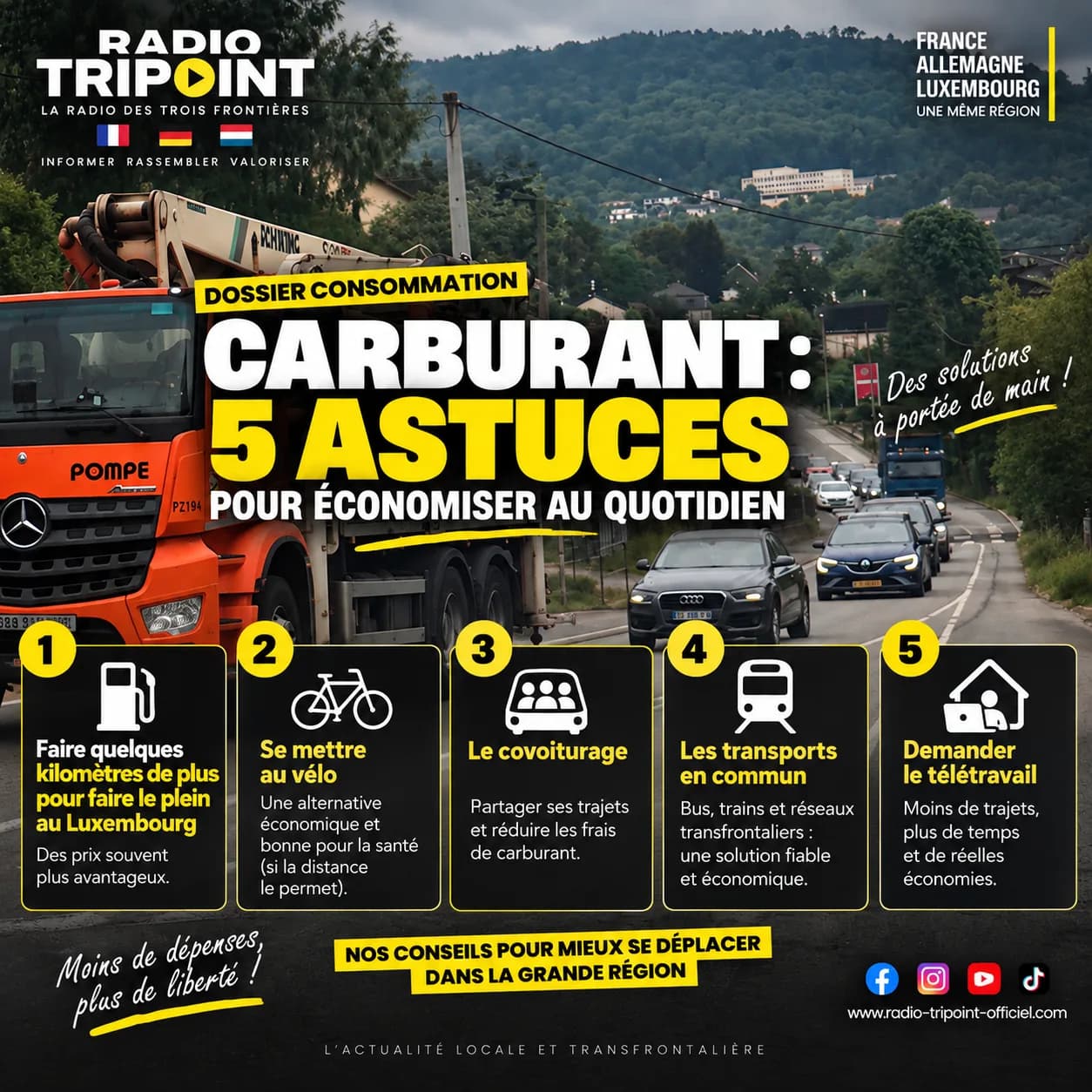
The price of fuel is weighing more and more heavily on household budgets. For people in the Greater Region who regularly cross the border to work, shop or take their children somewhere, the car is often hard to replace. But a few habits can help bring the bill down.
1. Drive a few extra kilometres to fill up in Luxembourg
For residents of the Three Borders, Luxembourg can be an interesting option for fuel. Depending on the period and the price difference, a few extra kilometres can bring savings.
But be careful: always factor in the cost of the extra journey. Driving 20 kilometres further just to save a few cents per litre isn't necessarily worth it.
2. Switch to the bike… when the distance allows
For short everyday journeys, the bike can be a real alternative to the car.
Fetching bread, getting to work if it's nearby, taking the children or doing other local trips by bike directly reduces fuel consumption.
And for longer distances, an e-bike can open up even more possibilities.
3. Think about car-sharing
If several people make the same journey every day, why not share the car?
Car-sharing spreads the cost of fuel while reducing the number of vehicles on the road.
In border regions, where many workers make the same journeys every day between France, Germany and Luxembourg, this solution can be particularly worthwhile.
4. Choose public transport
Buses, trains and cross-border connections can also help you leave the car at home.
Depending on where you live and work, combining several modes of transport can sometimes be cheaper than driving the whole way every day.
A simple habit: regularly compare the cost of a car journey with that of a public transport pass or ticket.
5. Talk to your employer about working from home
If your job allows it, working from home can also have a direct impact on your fuel budget.
One or two days a week working from home means several fewer journeys a month. For cross-border commuters who sometimes cover several dozen kilometres a day, the savings can quickly add up.
Of course, the possibility of working from home depends on the job, the company and the rules that apply to cross-border workers.
Conclusion: every journey avoided counts
Faced with changing fuel prices, there isn't necessarily one single solution. It is often the sum of small changes that brings the bill down: choosing where to fill up, sharing journeys, using public transport more often or cutting back on some car trips.
In a region where borders are crossed every day, rethinking your mobility can therefore become a real economic issue for households.