THE ECONOMIST: WHY DOES THIS MAGAZINE'S COVER STIR UP SO MUCH FASCINATION ABOUT THE FUTURE OF THE WORLD?
Every year, as the new year approaches, a British publication draws attention far beyond the circle of economists and geopolitics specialists. Its name: The Economist. More specifically, its annual cover.
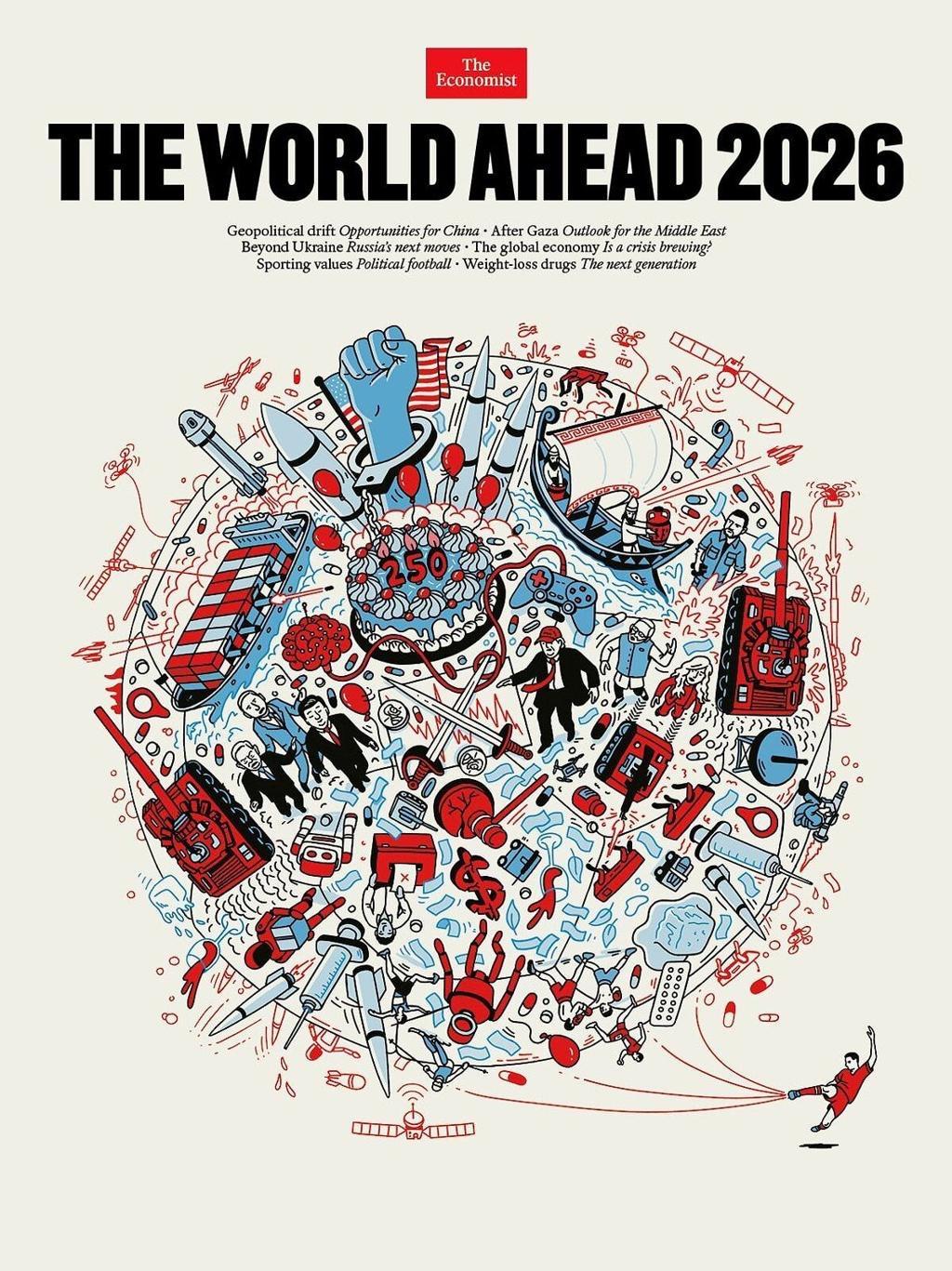
A cover that has become a genuine media event!
Founded in 1843, The Economist is a British magazine devoted to economics, politics, international affairs and the major transformations of society. It has gradually established itself as an influential publication among economic decision-makers, political leaders, investors and international observers.
But what particularly captures the attention of the general public is its annual edition entitled 'The World Ahead'.
Published every year in November, this edition offers a forward-looking reading of the events and trends likely to shape the following year. Journalists, economists, political figures and international experts set out and compare their analyses in its pages.
Over time, its cover has become an event in its own right. It is often a dense illustration, made up of figures, objects, historical references and symbols that seem to tell, in their own way, the story of the world's major concerns.
Images that fuel every kind of interpretation
It is precisely this visual dimension that has helped turn The Economist's cover into a phenomenon on social media.
Missiles, political leaders, syringes, robots, satellites, currencies, aeroplanes, medical items and symbols of power: every detail seems as though it could point to an international issue.
Some see it as a graphic summary of the topics covered in the magazine. Others go much further and try to identify hidden messages, advance announcements or even scenarios supposedly already known to certain economic and political elites.
Online, the interpretations multiply. Internet users link certain symbols to wars, financial crises, health upheavals or major political changes.
This fascination rests above all on one question: how can a magazine sometimes highlight events or tensions that do indeed become major issues a few months later?
There is, however, an essential distinction. Anticipating a trend on the basis of economic, political or military signals that are already observable does not mean secretly knowing the future. Nor is a symbolic illustration proof that an event had been planned.
2027: a world under strain at the heart of concerns
The new edition, 'The World Ahead 2027', unveiled in November 2026, has not gone unnoticed.
Once again, The Economist highlights several transformations likely to reshape the global balance.
Among the main topics announced is, first of all, the post-Trump era. The magazine considers the political future of the United States and the consequences of the end of Donald Trump's current political cycle. It believes this transition could be particularly turbulent.
Another major issue: the consequences of the war in Iran. The repercussions could extend well beyond the region, notably affecting energy supplies, the diplomatic balance and food security.
Artificial intelligence also takes centre stage. Beyond its technological promise, The Economist stresses the financial, political and cyber risks associated with its rapid development.
Climate change also features among the major concerns, with the prospect of another year marked by extreme temperatures, wildfires and droughts.
In Europe, the magazine looks at the rise of populist movements and the possibility of Marine Le Pen winning the 2027 French presidential election. According to its analysis, such a scenario could trigger political and economic upheaval within the European Union.
Finally, pressure on bond markets, tensions over Taiwan, weight-loss drugs, space exploration and the transformation of the film industry round off the picture.
Predictions, analysis or coded messages: where does the truth lie?
This is where the phenomenon becomes particularly interesting.
The Economist's cover is often presented on social media as a kind of map of the future. Some internet users claim that the magazine announces major events in advance, sometimes even international crises.
To understand this reputation, several mechanisms need to be taken into account.
First, the magazine has considerable capacity for international analysis. Its journalists follow political decisions, economic developments, military balances of power and technological change. It is therefore logical that it identifies certain trends before they become unavoidable events.
Second, the illustrations deliberately use symbols and compositions that make it possible to condense several topics into a single image.
Finally, social media plays a considerable role. Once an event occurs, some internet users dig out the cover and draw connections between the images and reality. The parallels sometimes seem unsettling, but they may also be the result of an interpretation made after the fact.
It is therefore important not to confuse journalistic foresight, symbolic reading and conspiracy theory.
A phenomenon that reveals our relationship with the future
Ultimately, the interest generated by The Economist goes far beyond the question of whether a cover can predict the future.
In a world marked by conflict, economic uncertainty, technological revolutions and climate upheaval, people are trying to understand what lies ahead.
The magazine's annual cover thus becomes a canvas for collective projection. Everyone looks in it for answers, warnings or clues to help them better grasp the months ahead.
It also reveals a reality: information is no longer limited to reading articles. Images, symbols and content shared on social media now play a part in shaping our perception of international news.
One thing is certain: The Economist does not have a crystal ball. But its ability to put major global trends into perspective explains why its annual cover has become an object of fascination. And what if the real challenge were not to uncover hidden predictions, but rather to understand the signals the world is already sending us?
Radio Tripoint – Understanding the world, decoding the news.
Read also
The whole section News
NewsSierck-Les-Bains
In Sierck-les-Bains, the Fée Kdo association puts solidarity at the heart of the festive season
2 min read

NewsSierck-Les-Bains
Christmas markets: the Three Borders get ready to make the festive magic shine
2 min read